
Choose Commercial Garage Door Openers That Match Your Dock Traffic
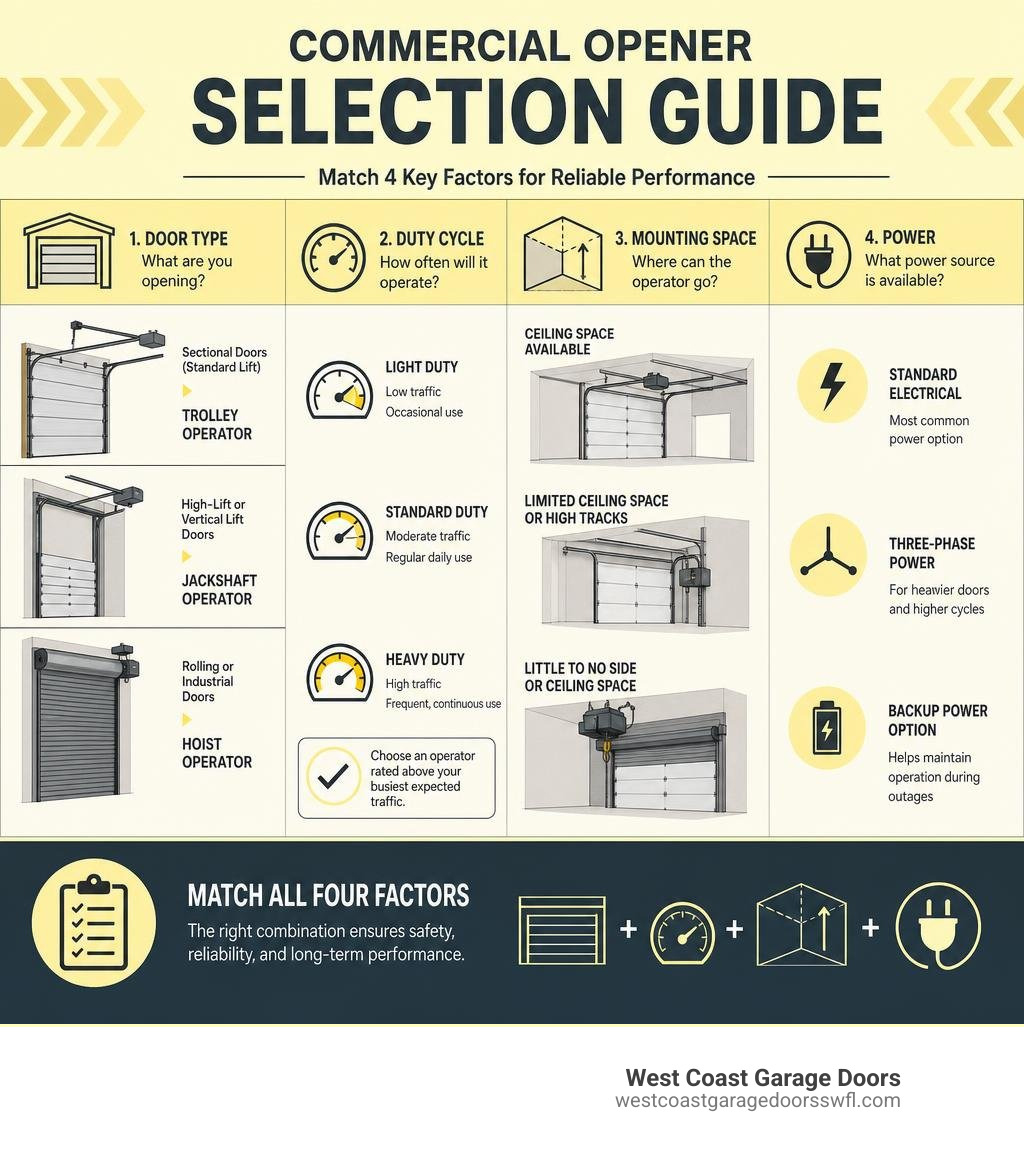
The right commercial garage door opener matches your door type, available space, power supply, and number of daily open-and-close cycles. Choose a trolley operator for standard-lift sectional doors with ceiling room, a jackshaft operator when overhead space is tight or tracks are high-lift, and a hoist operator for heavier rolling or industrial doors. Most importantly, select a duty rating that exceeds your busiest expected traffic.
A door that cannot open at a loading dock can delay shipments, expose inventory, and create a safety problem. Light-duty operators may suit low-use service bays, while busy warehouses and multi-bay facilities often need standard- or heavy-duty equipment rated for far more cycles per hour.
This roundup explains the operator types, safety features, smart controls, and power options that help commercial doors run reliably – and helps you make a cost-conscious choice before downtime becomes an emergency.
Key Types of Commercial Garage Door Openers for Modern Facilities
Selecting the correct commercial drive system depends directly on the structural design of your facility and the track profile of your commercial garage doors. Commercial doors operate under substantial tension and weight, requiring drive mechanics that distribute torque safely while matching available wall and ceiling clearances.
Commercial operators primarily fall into three categories: trolley, jackshaft, and hoist operators. While they all perform the primary task of opening and closing large barriers, their physical footprint and drive mechanisms serve distinct door architectures.
| Operator Type | Mounting Position | Best Door Types | Space Requirements | Key Advantage |
|---|---|---|---|---|
| Trolley | Suspended from ceiling center | Standard-lift sectional doors | Requires clear overhead ceiling space | Push-pull direct drive prevents panel binding; cost-effective |
| Jackshaft | Wall-mounted beside door | High-lift & vertical-lift sectional, rolling grilles | Requires side clearance (12–15+ inches); zero ceiling intrusion | Leaves ceiling clear for forklifts, lighting, and overhead storage |
| Hoist | Wall- or hood-mounted beside door | Heavy rolling steel doors, industrial vertical lift | Requires robust wall structure & side clearance | Integrated manual chain hoist for emergency manual operation during outages |
Trolley Operators for Standard Lift Doors
Trolley operators are the industry standard for commercial sectional doors equipped with standard lift tracks. Mounted directly to the ceiling structure, a trolley unit utilizes a central rail and carriage arm connected directly to the top panel of the door. This configuration applies consistent push-down and pull-up force along the path of travel.
Because trolley systems direct force straight through the central horizontal plane, they provide smooth motion and minimize stress on individual rollers and hinges. Many modern commercial trolley units feature advanced monitoring systems with built-in maintenance alerts and instant auto-reverse mechanisms that prevent door binding.
For facilities throughout Southwest Florida that utilize standard-profile overhead sectional doors, trolley operators represent one of the most cost-effective, straightforward equipment choices available.
Jackshaft and Hoist Operators for High-Lift Systems
When high ceilings, overhead cranes, or stacked pallet racks prevent you from hanging an operator in the middle of the room, side-mounted units solve the problem. Jackshaft operators mount directly to the wall beside the door and couple directly to the door’s torsion shaft and cable drums. As the motor turns the torsion bar, the cables wind or unwind, lifting the door smoothly without requiring any center track overhead.
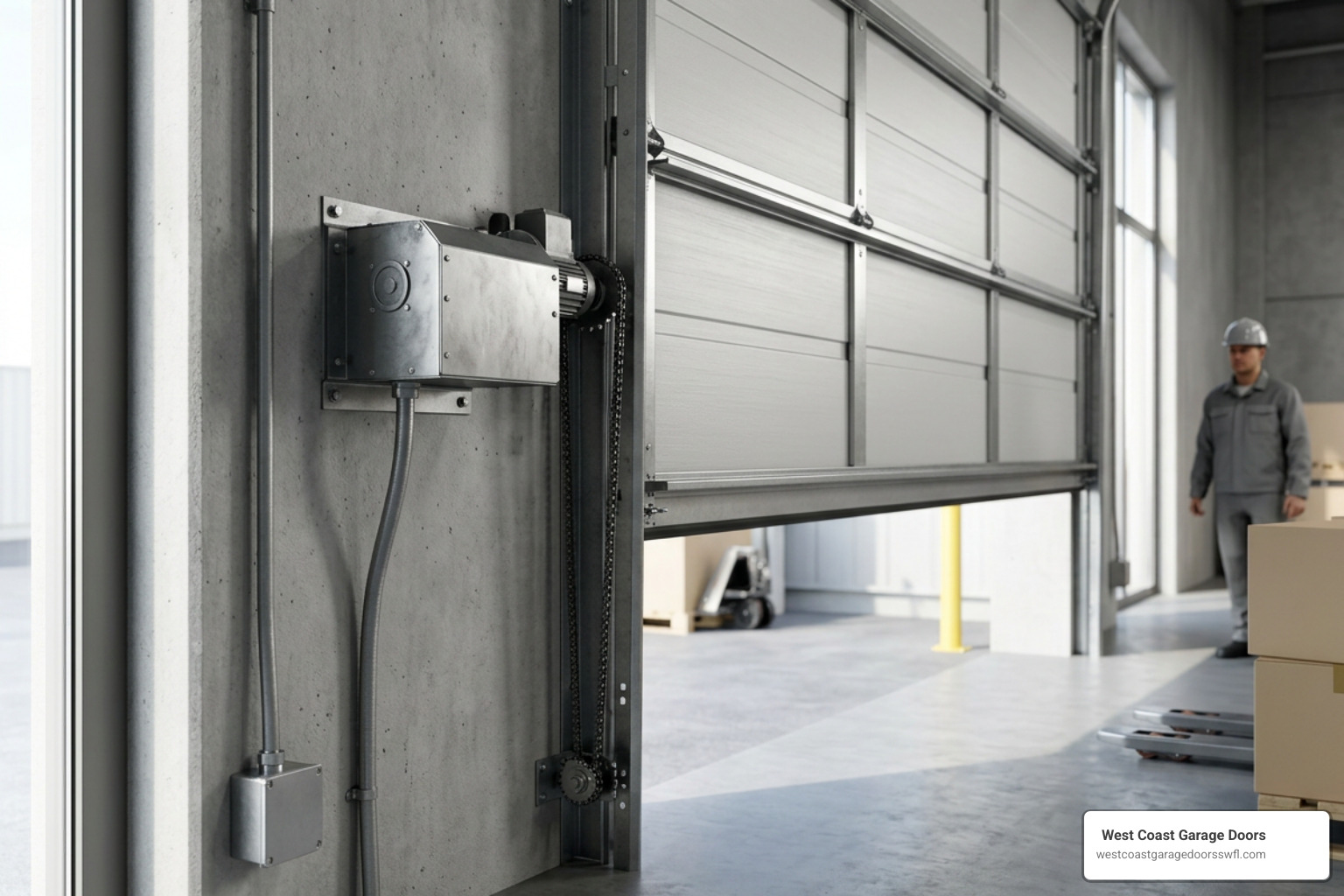
These units are built for high-lift sectional doors, full-vertical lift setups, and rolling grilles. For applications where ultra-quiet operation and streamlined profiles are desired, models like the LiftMaster LJ8900W Operator offer smooth DC wall-mount performance with integrated connectivity.
For heavy industrial applications and massive rolling steel doors, hoist operators take jackshaft mechanics a step further. Hoist operators incorporate an integrated, geared continuous-chain hoist assembly. If a severe tropical storm cuts electrical power across coastal commercial corridors, your warehouse staff can manually pull the chain to open or secure massive loading dock doors quickly and safely.
Choosing Duty Cycles and Motor Power for Facility Performance
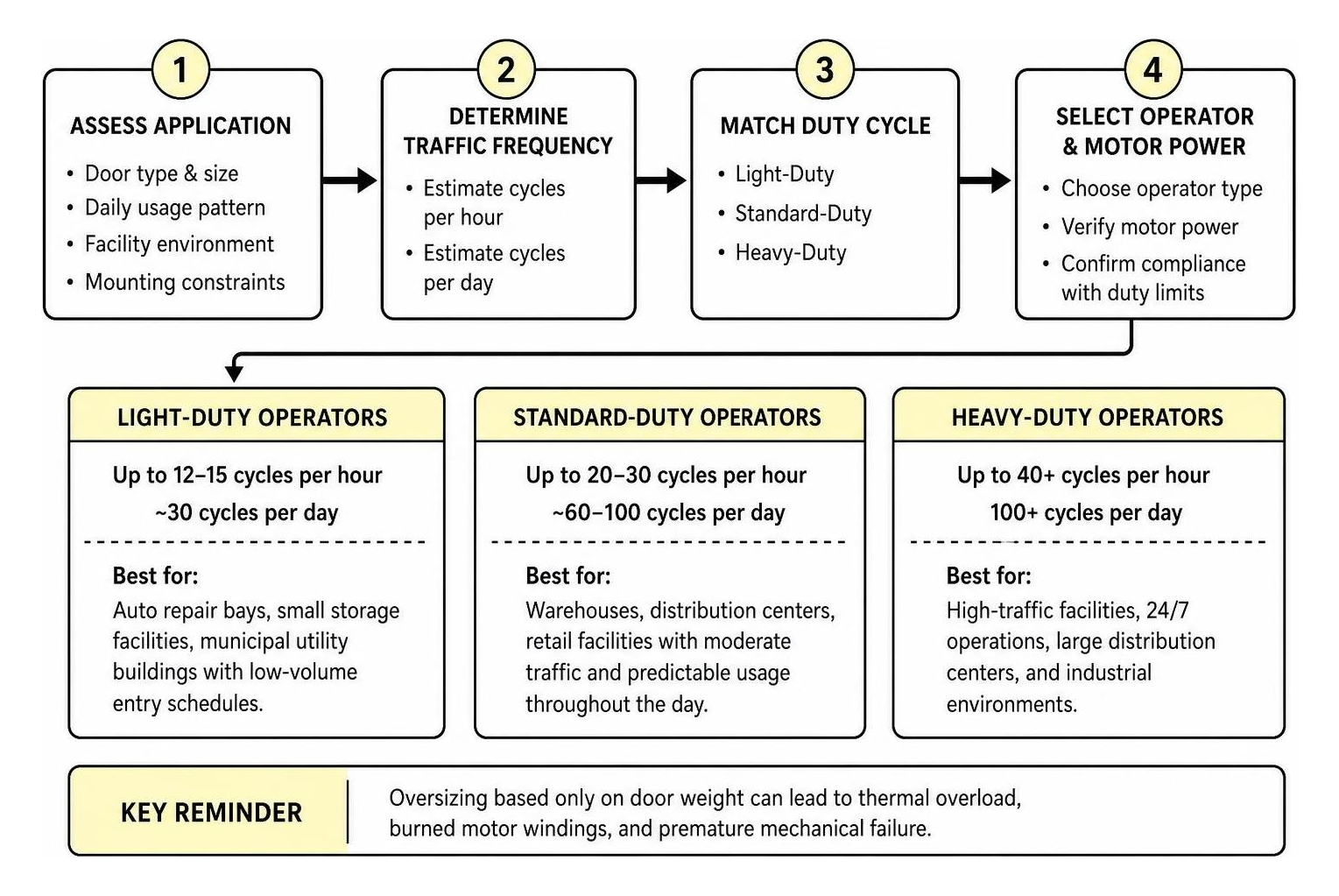
A common error in commercial facility planning is sizing an operator purely on the physical weight of the door while ignoring traffic frequency. In busy distribution centers, commercial garage openers that run beyond their designed duty limits experience rapid thermal overload, burned motor windings, and premature mechanical failure.
Selecting Duty Cycles for Commercial Garage Door Openers
Commercial operators are categorized into standard duty tiers defined by hourly cycle capacities and maximum daily operations:
- Light-Duty Operators: Rated for up to 12 to 15 cycles per hour and roughly 30 cycles per day. These suit auto repair bays, small storage facilities, or municipal utility buildings with predictable, low-volume entry schedules. Units such as the direct-drive platform detailed in the Genie Model 4064 Spec Sheet deliver 1¼ HPc lifting capacity with an opening speed of 12.0 inches per second for low-cycle applications up to 14 feet tall.
- Medium-Duty Operators: Typically handle up to 15 cycles per hour and roughly 50 cycles per day, providing a balanced solution for mid-sized freight depots and agricultural facilities.
- Standard-Duty Operators: Designed for up to 30 cycles per hour and 60 to 90 cycles per day, accommodating active shipping hubs and busy commercial parking garages.
- Heavy-Duty and Continuous-Duty Operators: Engineered to withstand 25 to 60+ cycles per hour and well over 90 to 100+ cycles per day. Industrial workhorses in this class feature continuous-duty motors, oil-bath gearboxes, and heavy solenoids built to run almost constantly during peak shift rotations without overheating.
Matching the duty class to your busiest operational hours protects equipment and ensures predictable loading schedules.
Voltage Options and High-Capacity Motor Sizing
Commercial facilities operate on varied electrical infrastructures. While light-duty operators frequently utilize single-phase 115V or 230V alternating current, industrial facilities rely on 3-phase power (208V, 230V, or 460V) to maximize motor efficiency and reduce line amperage.
Industrial platforms like the GH – Elite Commercial Door Operators provide continuous-duty performance across motor ratings from 1/2, 3/4, 1, 1-1/2, 2, up to 3 HP. These heavy-duty gearhead hoist models support both single-phase (115V/230V) and three-phase (208V/230V/460V/575V) wiring configurations. Equipped with heavy-duty worm-gear reduction mechanisms in an oil bath, they handle continuous high-cycle operations at industrial docks and large rolling fire barriers.
If an undersized unit has already begun to slip, stall, or overheat in your loading bay, our commercial repair service team can diagnose the mechanical load, re-tension the counterbalance springs, and evaluate your motor’s electrical draw to get your facility back on schedule.
Essential Safety Standards and Smart Automation Upgrades
Industrial overhead doors represent some of the heaviest moving equipment in any facility. Safe, regulated operation protects employees, prevents vehicle damage, and keeps your facility compliant with federal and municipal workplace safety regulations. Partnering with an experienced, professional garage door supplier ensures your access equipment meets current building codes and incorporates practical control accessories.
Upgrading Controls and Remotes on Commercial Garage Door Openers
Commercial operators typically come standard with interior 3-button wall stations configured for separate Open, Close, and Stop functions. However, modern operational demands often require retrofitting legacy operators with specialized control accessories:
- External Radio Receivers: Modern multi-frequency radio receivers can be wired directly to standard open/close terminal strips on older operators, enabling long-range remote operation for forklift drivers without replacing entire motor heads.
- Multi-Button Transmitters: Handheld remotes (ranging from 1-button to 3-button commercial models) allow operators to target individual loading bays from moving machinery, streamlining loading dock traffic.
- Exterior Key Switches and Card Readers: Exterior-mounted key switches, waterproof numeric keypads, and badge readers provide secure, authorized building access for after-hours logistics teams.
UL 325 Safety Compliance and Environmental Ratings
Under federal safety regulations, all commercial operators manufactured and installed today must comply with the UL 325 safety standard. This requires continuous monitoring of secondary entrapment protection devices whenever an operator is configured for momentary-contact closing (where a single button press automatically closes the door).
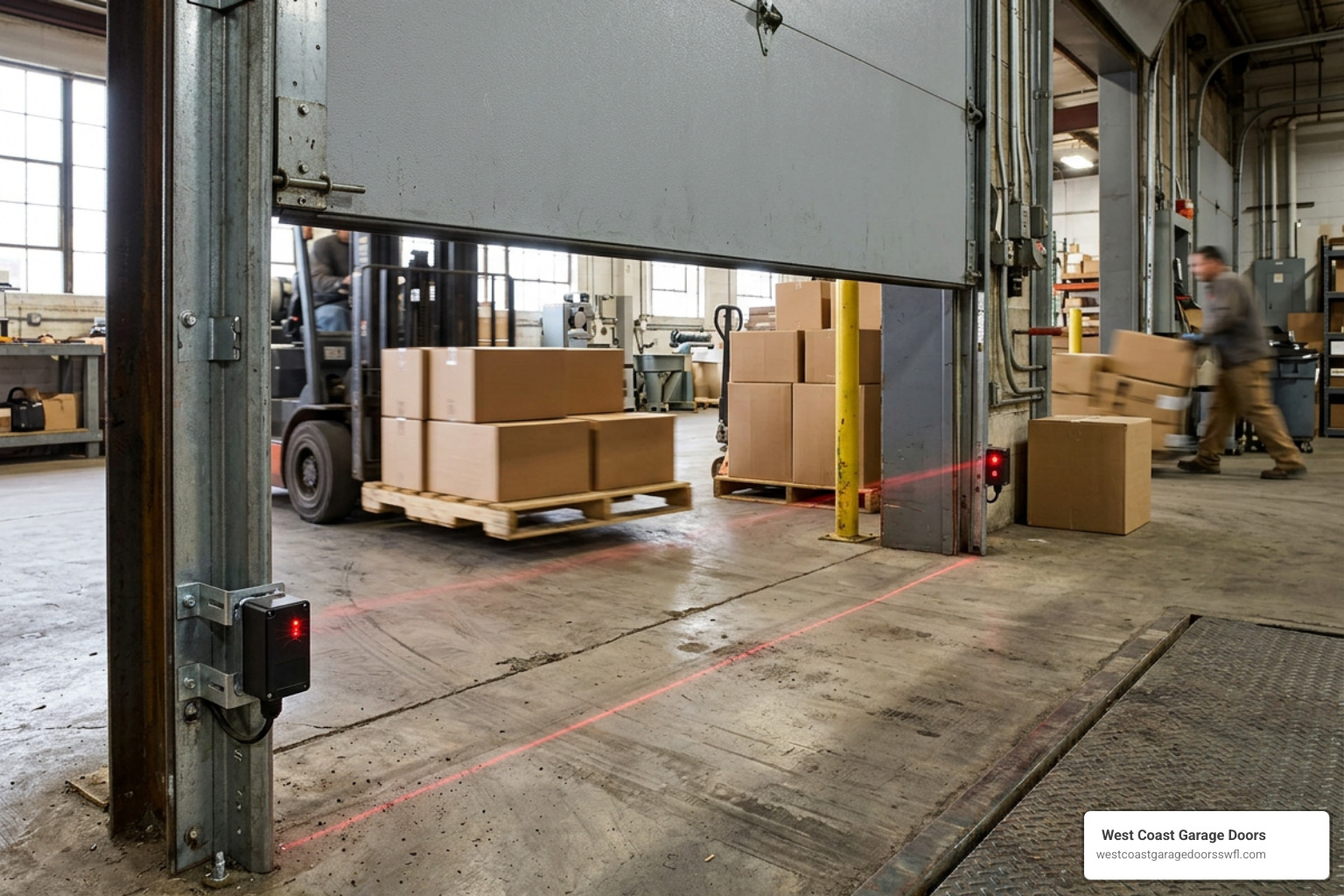
Key safety mechanisms and specialty modifications include:
- Monitored Photoelectric Eyes: Heavy-duty infrared photo eyes cast a continuous optical beam across the door threshold; breaking the beam immediately stops and reverses downward door travel.
- Pneumatic and Electric Sensing Edges: Installed along the bottom rubber astragal of the door, these pressure-sensitive edges trigger an immediate reversal upon physical contact with an obstruction.
- NEMA 4/12 Enclosures: Watertight and dust-tight control housings designed for food processing plants, wash bays, or humid environments.
- NEMA 4X Corrosion-Resistant Housings: Essential for coastal commercial installations across Southwest Florida, shielding sensitive electronics from salt air and harsh moisture.
- Explosion-Proof Modifications: Specialized, sealed enclosures certified (e.g., Class I, Group D; Class II, Groups F & G) for chemical storage depots, fuel transfer stations, and grain handling operations where atmospheric vapors or combustible dust create flash fire risks.
Smart Monitoring and Facility Dock Management
Commercial door automation has evolved into complete cloud-connected building intelligence. Platforms like myQ Smart Facility Access integrate directly into modern commercial operators, giving operations managers complete visibility over their logistics footprint.
Using connected commercial platforms, facility directors can track dock door status in real time, monitor open-door cycle durations, review loading dock dwell times, and receive instant smartphone or desktop alerts if a security perimeter remains open after hours.
Configurable programmable timer-to-close functions (adjustable in precise increments) ensure that doors seal automatically once transport trucks pull away. This improves climate control, protects refrigerated inventory, and enhances perimeter security across your facility.
Frequently Asked Questions About Commercial Door Operators
How do duty cycle ratings impact commercial opener longevity?
Duty cycle ratings determine the thermal capacity of the operator’s motor and drive gears. When an operator is forced to run beyond its rated cycles per hour, internal thermal overload switches trip to prevent total motor failure, shutting the door down temporarily.
Consistently exceeding these duty boundaries degrades motor insulation, strips drive gears, and significantly shortens the lifespan of the equipment. Choosing a higher duty class than your minimum daily average ensures cool, steady operation during unexpected logistics surges.
What is the difference between trolley and jackshaft commercial openers?
A trolley operator mounts directly to the ceiling and pushes/pulls the top section of a standard-lift sectional door along a horizontal rail.
A jackshaft operator mounts directly to the wall beside the door, driving the torsion shaft and cable drums directly. Jackshaft operators eliminate overhead tracks, making them the preferred choice for high-lift sectional doors, vertical-lift doors, rolling steel doors, and buildings with high ceiling clearances or overhead crane systems.
Can radio controls and modern remotes be added to older commercial operators?
Yes. Most commercial operators feature standard low-voltage terminal blocks on their logic boards (typically labeled for Open, Close, Stop, and Common).
By connecting a compatible commercial radio receiver to these terminals and supplying low-voltage transformer power, you can retrofit legacy systems to accept modern rolling-code remotes, multi-door transmitters, and wireless keypads without replacing the existing motor assembly.
Conclusion
Reliable commercial door operators are the backbone of efficient warehouse workflows, service bay operations, and commercial loading docks. Selecting the right combination of mounting style, continuous-duty motor power, UL 325 safety devices, and intelligent facility monitoring prevents costly operational bottlenecks and keeps your business running on schedule.
Whether you are outfitting a new industrial park or need same-day diagnostic service on an overworked loading dock operator, our team provides experienced commercial door installations, maintenance, and hurricane-rated solutions tailored to your facility’s exact requirements.
Contact our team today for expert commercial door services in Cape Coral and across Fort Myers, Naples, Bonita Springs, and our surrounding Southwest Florida communities.