
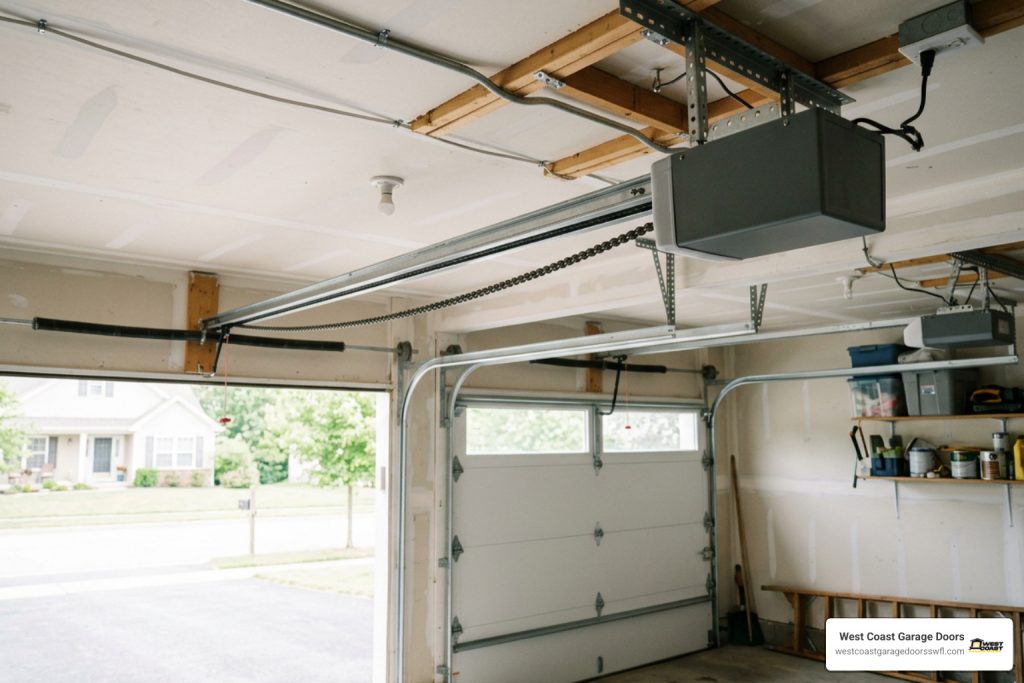
A Chain Drive Garage Opener Is Built for Strength and Value
A chain drive garage opener is often the best fit when you want dependable lifting power at a lower price than many belt-drive models. Its steel chain is tough, works well with heavier doors, and is a practical choice for detached garages where extra operating noise is less of a concern.
For most homes, choose:
- 1/2 HPc for a standard, well-balanced single or double garage door.
- 3/4 HPc for heavier insulated doors, hurricane-reinforced doors, or frequent daily use.
- Battery backup for access during Florida power outages.
- Wi-Fi controls and safety sensors for remote monitoring and safer operation.
Chain systems do make more noise than belt drives because metal components move along the rail. In return, they offer a rugged design, straightforward maintenance, and strong value. With proper chain tension, lubrication, and a balanced door, a quality opener can provide roughly 10 to 12 years of service.
Why Choose a Chain Drive Garage Opener Over Belt and Screw Systems
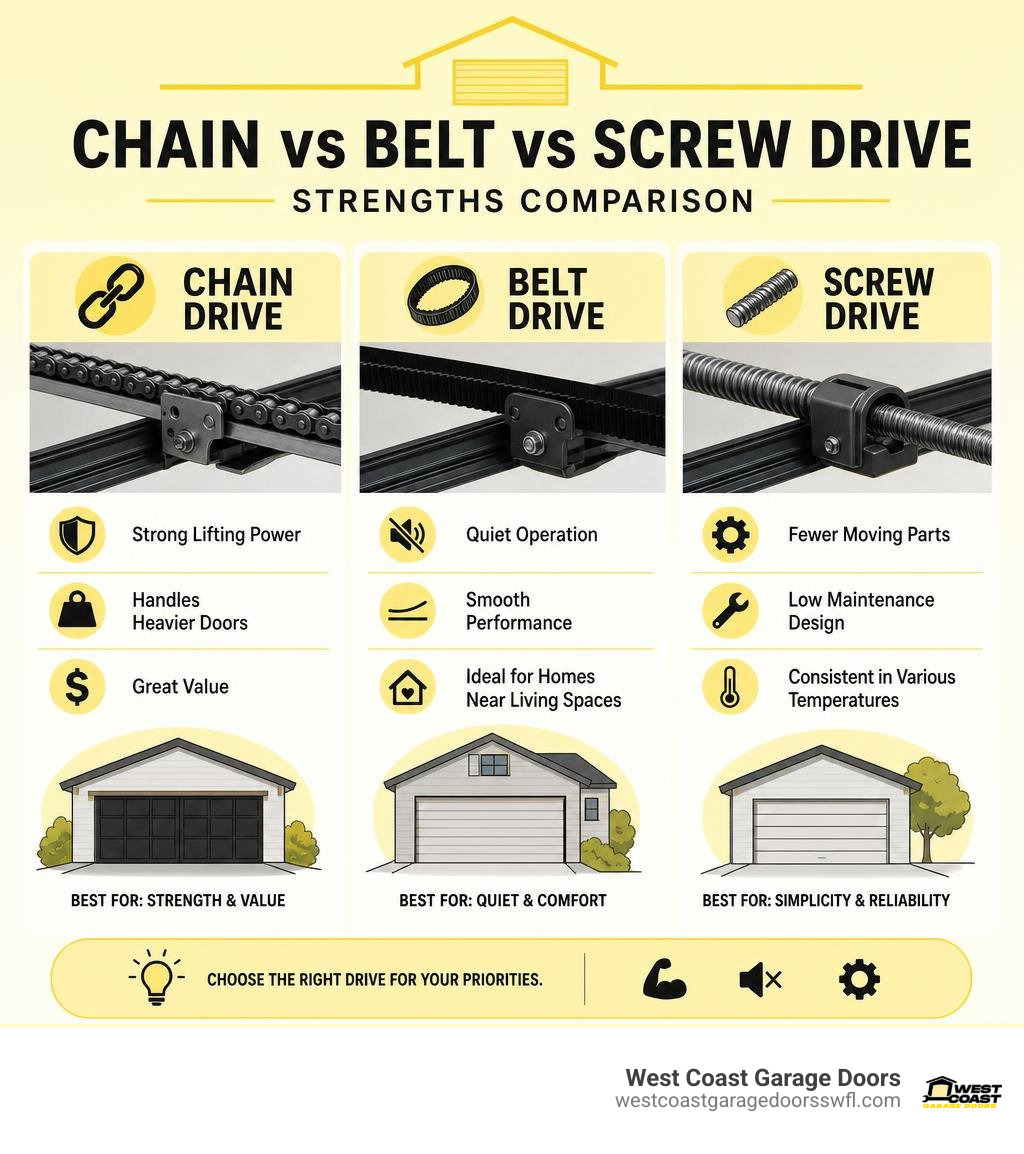
When upgrading or replacing an overhead door setup, picking the right drive mechanism is the biggest decision you will face. Chain-driven units account for roughly 60% of the residential market for good reason: their mechanical tensile strength is unmatched in the entry-to-mid price tier. A classic steel bicycle-style chain or full roller chain pulls a trolley along a steel rail, converting raw motor torque into direct vertical lift without slipping or stretching under heavy loads.
Belt drives use steel-reinforced rubber or polyurethane belts to glide silently, while screw drive systems spin a threaded steel rod to shuttle the trolley back and forth. While belt systems excel in whisper-quiet performance and screw drives offer fewer moving components, chain drives remain the undisputed workhorses for heavy doors, wind-rated panels, and detached workspaces where lifting muscle matters far more than silent operation.
| Feature | Chain Drive Opener | Belt Drive Opener | Screw Drive Opener |
|---|---|---|---|
| Drive Mechanism | Full steel roller/link chain | Steel-reinforced rubber/polyurethane belt | Threaded steel drive screw rod |
| Lifting Capacity | Exceptional (handles heavy/wind-rated doors) | Moderate to high (standard doors) | High torque (fewer moving parts) |
| Noise Level | ~65 dB (audible metallic hum) | ~55 dB (ultra-quiet) | ~60 dB (moderate hum) |
| Average Retail Cost | $160 – $300 (Most budget-friendly) | $240 – $450+ | $220 – $380 |
| Maintenance Need | Regular chain lubrication & tensioning | Minimal maintenance | Periodic low-temp gear grease |
| Ideal Application | Heavy doors, detached garages, rental homes | Attached garages near bedrooms | Wide, solid-wood, or single-piece doors |
If you are exploring the latest residential garage openers, weighing noise requirements against raw lifting performance helps pinpoint the best match for your home layout.
Comparing Noise Levels and Lifting Power
Chain drive units operate around an average volume of 65 dB, comparable to a normal conversation or a standard dishwasher running across the room. By comparison, modern belt drives glide along at roughly 55 dB. This sound difference comes directly from metal-on-metal movement: as the steel chain links engage the motor sprocket and travel along the steel T-rail or C-channel rail, natural mechanical vibrations occur.
For detached garages, outbuildings, workshops, or homes where the garage is located beneath unused utility spaces, this noise is completely harmless. In fact, many homeowners appreciate the gentle acoustic confirmation that someone is arriving home. Where lifting power is concerned, the steel chain will never snap, stretch, or strip under the sudden weight of a reinforced door, giving you maximum dependability season after season.
Long-Term Value and Maintenance Requirements
Chain drives consistently provide the best horsepower-per-dollar value in the garage door industry. With standard care, a quality chain system delivers an average lifespan of 10 to 12 years—often outlasting the structural components of the door itself.
To keep your opener humming happily without unexpected sprocket wear, plan a simple 10-minute maintenance routine every six months:
- Check Chain Tension: Ensure the chain hangs roughly 1/4 to 1/2 inch above the bottom of the rail. A sagging chain can slap the rail, while an overly tight chain strains the motor bearings.
- Clean and Lubricate: Wipe away grit, coastal dust, and old grease from the chain, then spray a non-silicone, garage-door-specific lubricant along the links.
- Inspect the Drive Sprocket: Look at the top teeth on the powerhead to verify they are straight and show no signs of metal shaving or premature wear.
Motor Ratings and Hardware Sizing for Heavy Doors
Choosing the correct motor size prevents premature burnout and ensures smooth, consistent travel. Residential chain openers utilize either traditional AC (alternating current) motors or newer DC (direct current) motors.
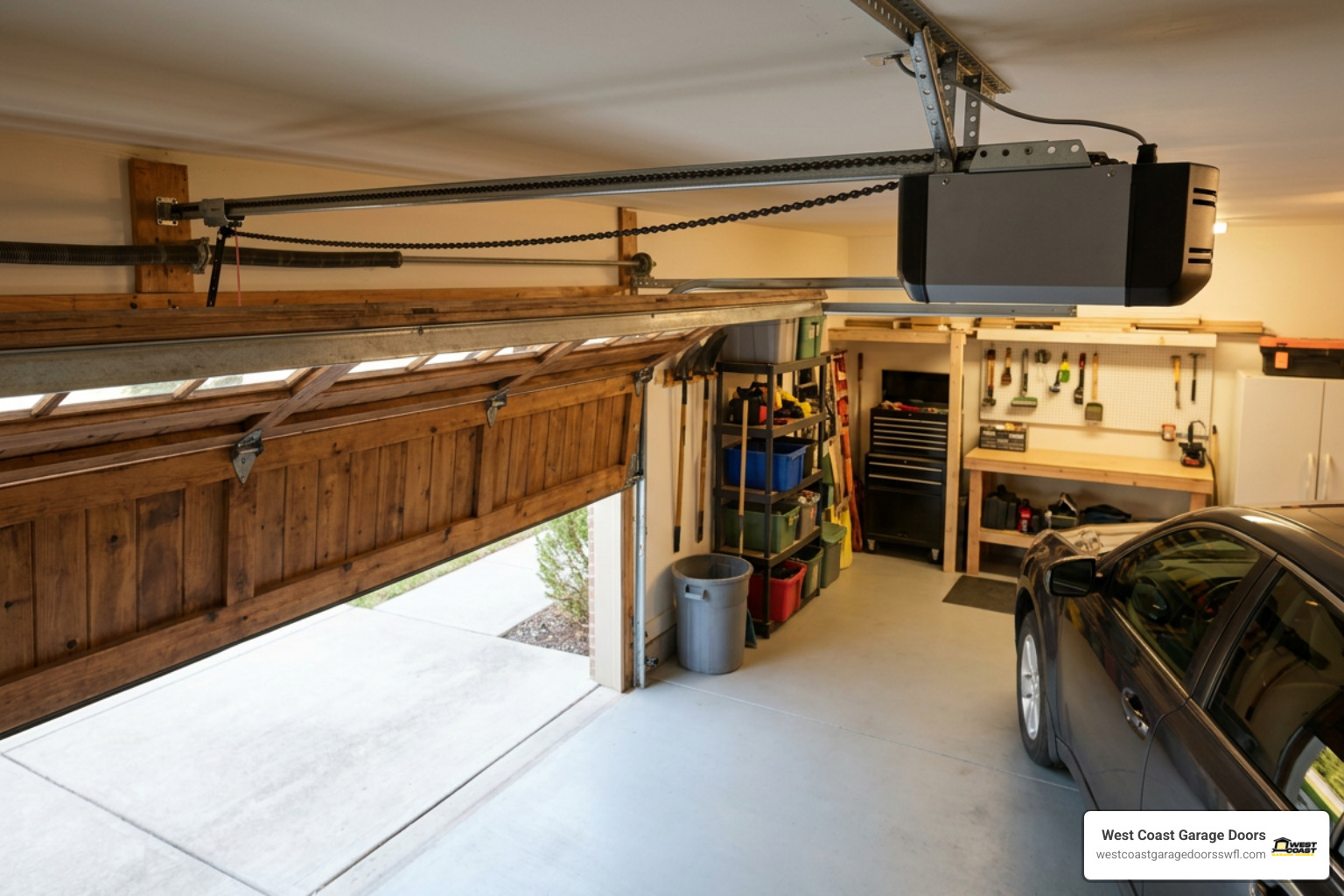
A heavy-duty AC motor, such as a 1/2 HP unit running at 1,625 RPM with an industrial 16:1 gear reduction, delivers steady travel speeds of 7 inches per second on both upward and downward cycles. Newer DC motors offer comparable lifting ratings (measured in Horsepower Similar, or HPc) while introducing soft-start and soft-stop technology that minimizes wear on garage door hardware.
Sizing Your Chain Drive Garage Opener by Horsepower and Door Weight
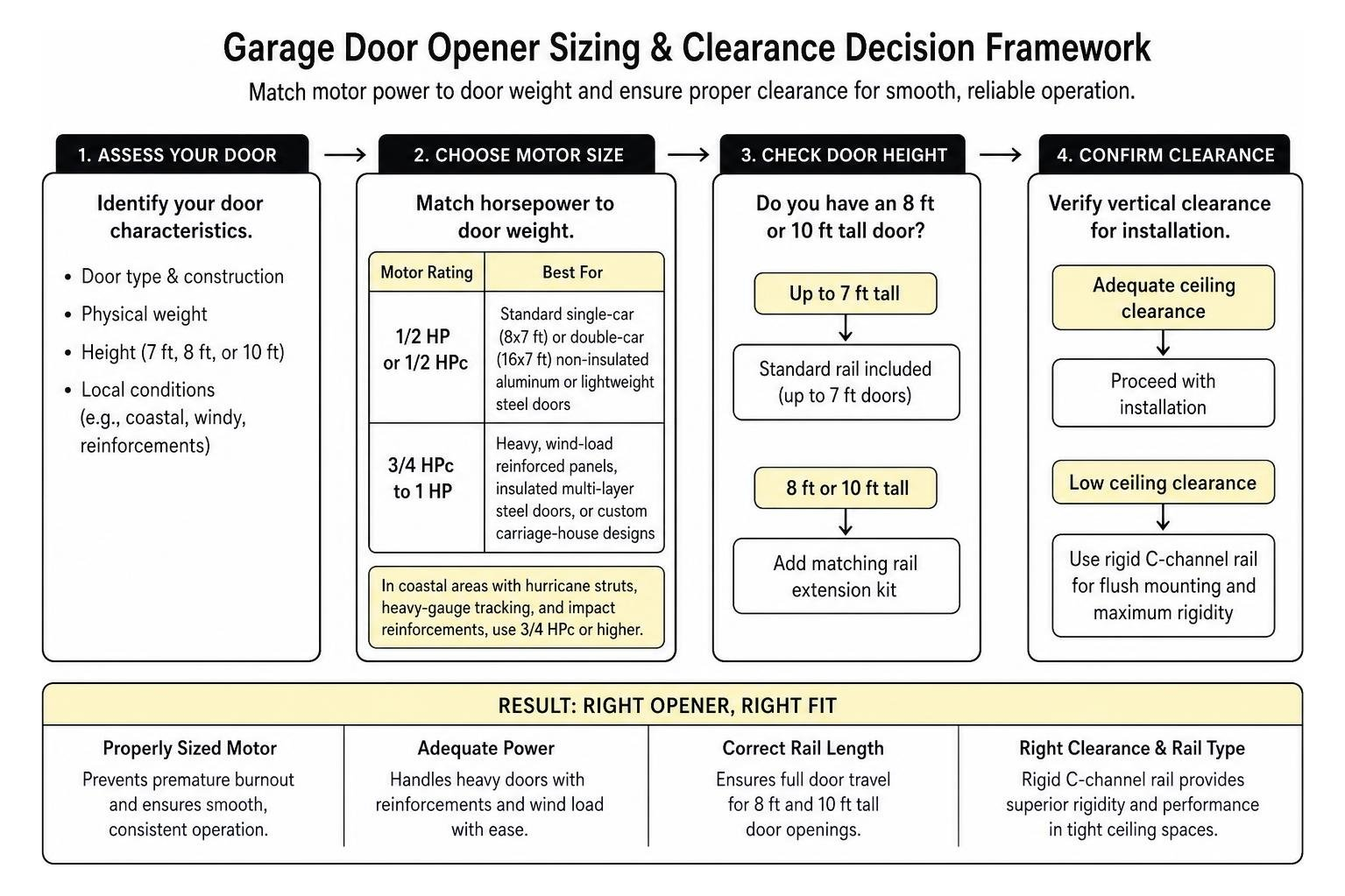
Matching horsepower to the physical weight of your door ensures your system never strains:
- 1/2 HP or 1/2 HPc: Perfect for standard single-car (8×7 ft) or double-car (16×7 ft) non-insulated aluminum or lightweight steel doors.
- 3/4 HPc to 1 HP: Required for heavy, wind-load reinforced panels, insulated multi-layer steel doors, or custom carriage-house designs. Premium units like the heavy-duty 3/4 HPc chain drive specifications highlight models capable of opening doors up to 7.5 inches per second with full 140V DC lifting power.
In coastal Florida areas like Cape Coral, Fort Myers, Sanibel, and Naples, garage doors are frequently equipped with heavy internal hurricane struts, heavy-gauge tracking, and impact-resistant reinforcements. Equipping these reinforced doors with a 3/4 HPc motor guarantees your opener effortlessly handles the extra structural weight.
Rail Extensions and Vertical Door Clearance
Standard residential openers ship with rails designed for doors up to 7 feet tall. If your garage features an 8-foot or 10-foot tall opening to accommodate lifted trucks, boats, or oversized SUVs, you will need a matching rail extension kit.
Rigid C-channel rails offer superior rigidity compared to multi-piece stamped rails, shielding the chain from dirt and moisture while allowing flush mounting in tight ceiling clearance applications.
Modern Smart Features, Security, and Battery Backup Integration
Today’s chain-driven openers combine heavy-duty hardware with modern digital conveniences. Security is no longer an afterthought: modern openers incorporate dynamic rolling-code technology (such as Security+ 2.0 or Intellicode) that generates a brand-new encrypted access code from billions of combinations every time you press your remote or keypad.
Long-range remotes now operate reliably from up to 1,500 feet away, allowing you to open the garage smoothly as you pull into your driveway.
Smart Connectivity and Remote Monitoring Capabilities
Built-in Wi-Fi logic boards connect your opener directly to home networks via mobile platforms like myQ or Aladdin Connect. Reviewing industrial-grade 1/2 HP AC chain drive opener data shows how modern logic boards combine surge suppression, thermal overload protection, and smartphone control into a single durable package.
Smart integration benefits include:
- Real-Time Push Notifications: Receive immediate alerts on your smartphone whenever your door opens, closes, or remains open past a preset duration.
- Custom Schedules: Set an automated “night lock” rule that verifies your overhead door is shut and secure every evening at 9:00 PM.
- Guest Access & Deliveries: Grant temporary or scheduled digital access to family members, dog walkers, or service providers without sharing physical keys or entry codes.
Reliable Emergency Battery Backup for Power Outages
During severe weather, tropical storms, and seasonal grid disruptions across Southwest Florida, losing power shouldn’t leave your vehicle trapped inside the garage. Modern chain openers frequently come equipped with integrated 12V battery backup systems.
These internal batteries automatically engage the moment utility power drops, supplying enough juice to operate the motor, safety sensors, and remotes for dozens of complete cycles until standard power is restored.
Installation Protocols and Troubleshooting Solutions
While many handy homeowners attempt a weekend DIY installation, hanging a heavy steel-rail opener requires precision. Securing the header bracket to solid structural framing, setting the drop angle, tensioning the chain drive assembly, and programming the open/close travel limits require standard mechanics’ tools (wrenches, socket sets, level, tape measure, and a sturdy step ladder).
If you run into balance issues or a broken torsion spring during setup, contact our team for emergency garage door repair to keep your family and equipment safe.
Maintaining Your Chain Drive Garage Opener for Long-Term Operation
A well-maintained chain opener will operate for decades with minimal fuss. Make sure your regular home upkeep includes an annual check on the door’s mechanical counter-balance system. An out-of-balance door places unnecessary strain on the opener’s drive gear and chain assembly.
If your door feels heavy or fails to move freely by hand, schedule our professional repair service to service the torsion springs, replace worn rollers, and re-align the tracks.
Troubleshooting Flashing Error Codes and Remote Range Issues
When an opener refuses to move, its onboard diagnostic LEDs will flash in specific sequences to tell you what is wrong:
- Continuous Flashing LED on Wall Console: The vacation lock or security lock is engaged. Press and hold the lock button for three to five seconds to disengage.
- Opener Starts Downward, Then Reverses and Blinks 10 Times: The infrared safety beams are misaligned, dirty, or obstructed. Clean the lenses and adjust the brackets until both sender and receiver show solid lights.
- Shortened Remote Range (Under 20 Feet): Often caused by nearby LED bulb radio frequency (RF) interference. Swap out generic household LEDs for shielded garage-door-rated LED bulbs.
- HomeLink In-Car Pairing Fails: Hold your handheld transmitter 2 inches from the vehicle mirror/console button while holding both down simultaneously until the indicator flashes rapidly, then tap the opener’s “Learn” or “PRG/SET” button to finalize pairing.
Frequently Asked Questions About Garage Openers
Can I reuse my existing rail when upgrading to a new chain opener?
In most cases, no. Even within the same brand family, modern openers use updated rail profiles, different drive sprocket gear ratios, and modified trolley stops. Reusing an old, worn rail with a new powerhead can cause chain binding, misaligned travel limits, and premature gear failure. It is always safest to install the brand-new rail assembly included in your opener kit.
How long does a chain drive garage door opener typically last?
A quality chain drive garage door opener typically lasts between 10 and 15 years. Premium models feature lifetime motor warranties, 15-year chain coverage, and robust internal gearboxes. In humid or coastal areas like Pine Island, Matlacha, or Bonita Springs, keeping the chain lubricated prevents salt-air oxidation and ensures maximum operational life.
What causes a chain drive opener to become excessively noisy?
Excessive noise is usually caused by three culprits: a loose chain slapping against the steel rail, dry unlubricated metal links grinding across the drive sprocket, or worn, unsealed steel rollers rattling inside the garage door tracks. Tightening the chain tension nut to manufacturer specs, applying non-drip garage lubricant, and upgrading old door rollers to sealed nylon units will dramatically quiet your system.
Conclusion
Choosing a chain-driven garage opener delivers the ultimate balance of heavy-duty lifting torque, proven mechanical durability, and long-term cost savings. Whether you need to lift an insulated hurricane-rated door or automate a busy workshop, a chain system stands up to rigorous daily use year after year.
At West Coast Garage Doors, our locally owned team provides prompt same-day service, top-tier equipment, and a 100% satisfaction guarantee. If you are ready for a worry-free upgrade, contact our expert installation team in Cape Coral or reach out through our contact page to schedule an on-site consultation today.