
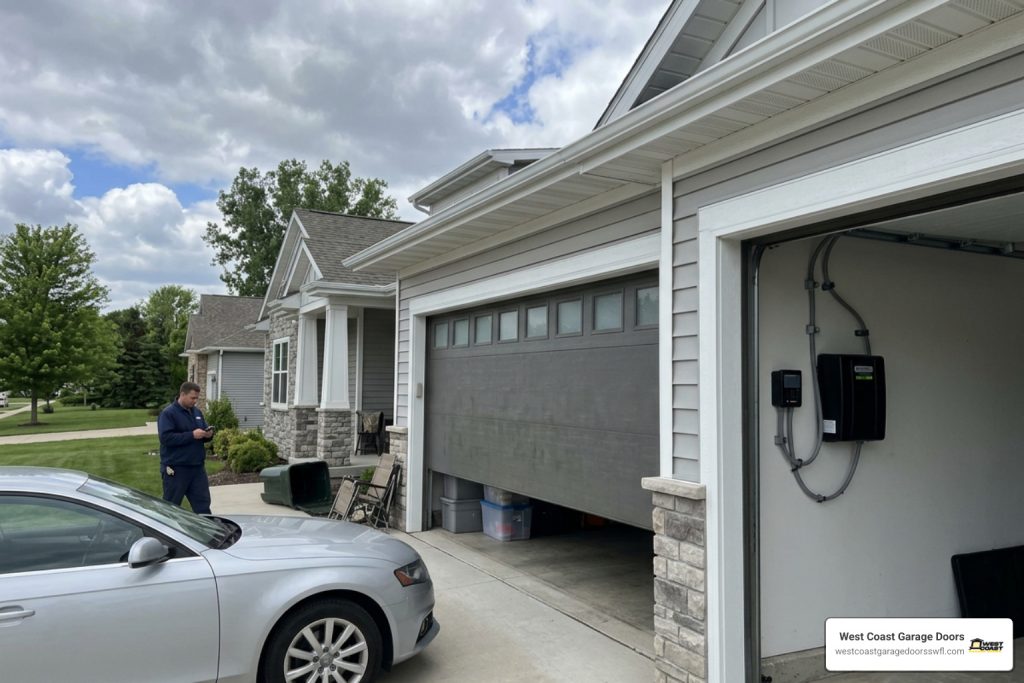
Choose a Garage Door Opener Battery Backup for Storm-Ready Access
A garage door opener battery backup keeps your door working when utility power fails. For Cape Coral and Fort Myers homeowners, the best choice is usually a compatible opener with an integrated backup battery or an OEM add-on kit made for the exact opener model.
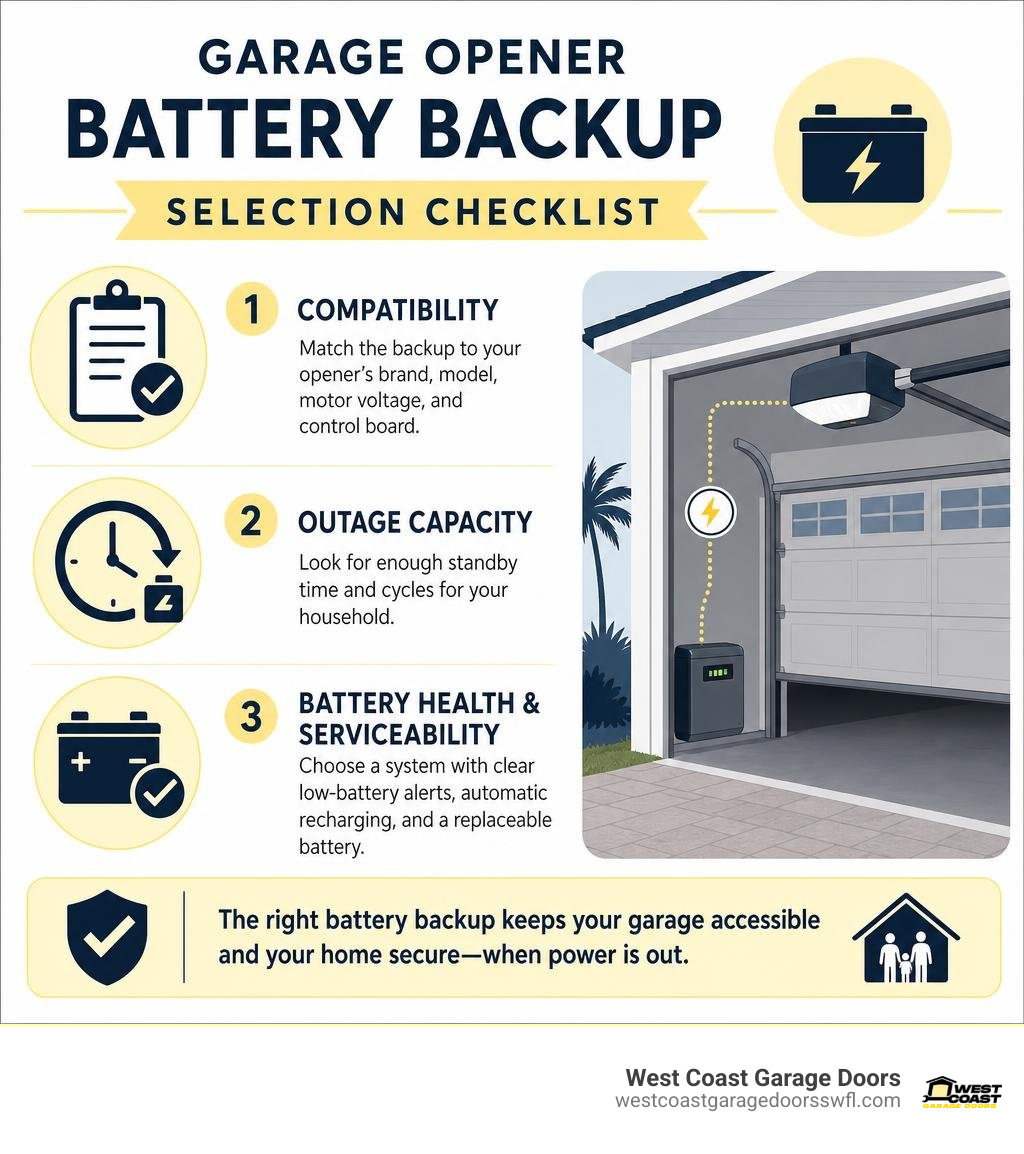
Before buying, check three things:
- Compatibility: Match the backup to your opener’s brand, model, motor voltage, and control board.
- Outage capacity: Look for enough standby time and cycles for your household. Depending on the system, a charged battery may provide about 24 hours of use or anywhere from a few to roughly 50 open-and-close cycles.
- Battery health and serviceability: Choose a system with clear low-battery alerts, automatic recharging, and a replaceable battery.
A backup is more than a convenience during hurricane season. It can provide a way to enter or exit the garage when the lights are out, without relying on the manual emergency release. It is also required for residential garage door openers sold or installed in California on or after July 1, 2019 under SB 969.
The right setup depends on whether your current opener supports a manufacturer-approved add-on battery. Many older units do not, so replacing the opener can be safer and more reliable than forcing a universal solution.
How a Garage Door Opener Battery Backup Works and Why You Need One
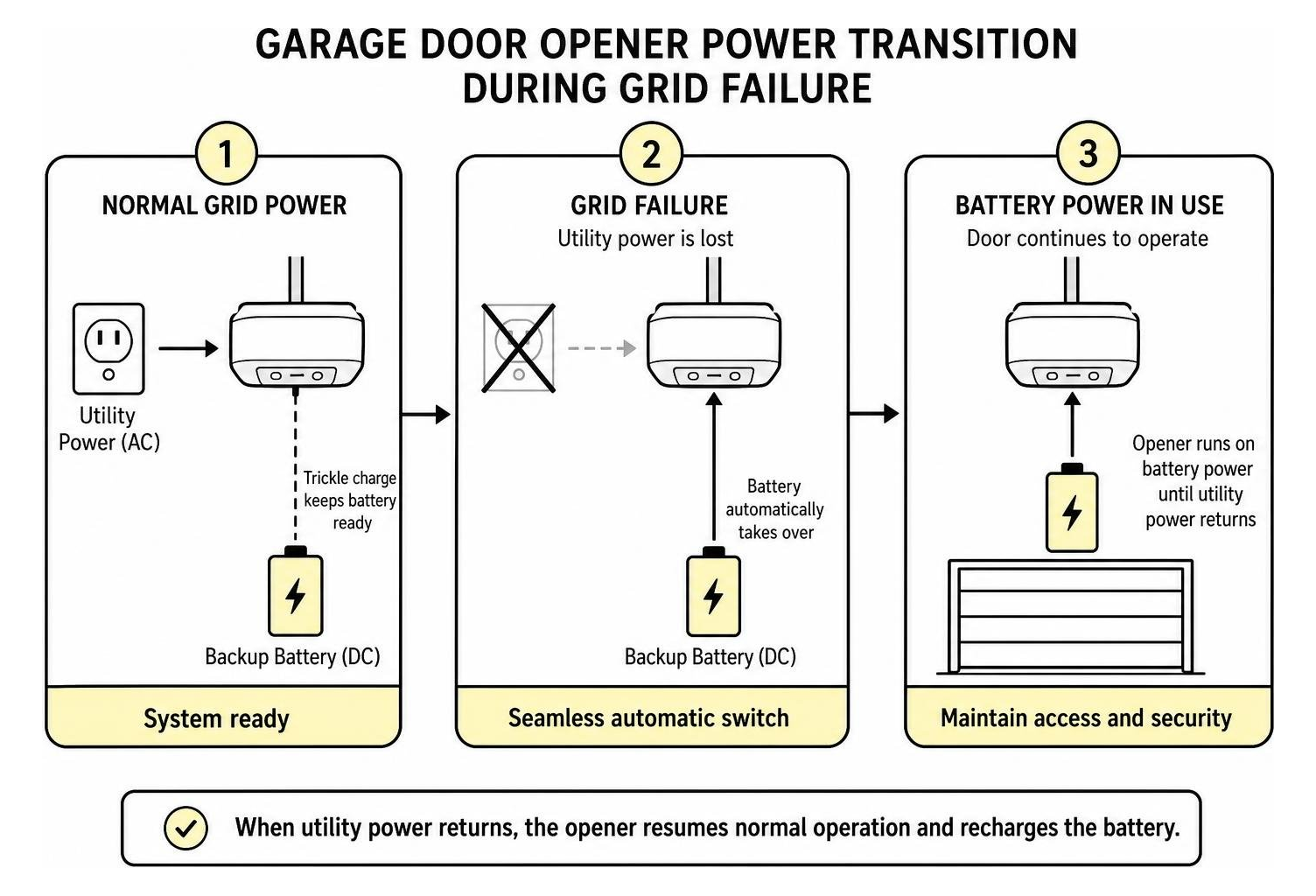
When standard electrical service cuts out, a garage door opener equipped with a backup power system seamlessly shifts from household alternating current (AC) to an internal direct current (DC) power reserve. Most modern garage systems rely on DC motors operating at 24 VDC or 140 VDC, which allows the motor to draw directly from a battery bank without requiring heavy external power converters.
During normal grid operation, the opener delivers a continuous trickle charge to keep the internal battery at peak capacity. When severe weather hits Southwest Florida—whether it is a summer afternoon thunderstorm or an intense tropical storm—the battery automatically assumes the electrical load the split second utility power drops.
The primary reason to equip your home with this technology is guaranteed emergency egress and security. When high winds and heavy rains arrive across Cape Coral, Fort Myers, Sanibel, Pine Island, Matlacha, Naples, and Bonita Springs, manual emergency release cords can be physically demanding or dangerous to operate, especially if the door is heavy or out of balance. Upgrading to modern garage openers ensures your family can safely park vehicles inside before a storm or leave quickly during an evacuation.
California SB 969 and Safety Regulations
While battery backups are a major convenience in storm-prone regions, they are also a strict legal requirement in other jurisdictions. California Senate Bill 969 (SB 969) was passed in response to devastating wildfires where residents became trapped behind heavy, non-functioning garage doors when the electrical grid failed.
Effective July 1, 2019, SB 969 mandates that all residential garage door openers sold or installed in California must be equipped with a functional battery backup system. Violations carry a civil penalty of $1,000 per non-compliant opener. This landmark safety legislation shifted the entire garage door manufacturing landscape, making DC-powered, battery-integrated motors the benchmark standard for homeowner safety nationwide.
Standby Power and Cycle Expectations
How long your garage door operates during a blackout depends on battery capacity, standby draw, and physical door mechanics:
- Standby Duration: Most standard backup batteries maintain active readiness for 24 to 48 hours after utility power drops.
- Cycle Count: A fully charged battery backup system supplies 24 VDC to the motor unit for one to two days of normal operation, delivering anywhere from 5 to 50 full open-and-close cycles depending on the model and motor voltage.
- Power Conservation: Opener systems enter an energy-saving standby mode during an outage, turning off internal work lights or reducing door travel speed to preserve battery life for critical lifting operations.
Integrated vs. Add-On Backup Systems: Choosing the Right Setup
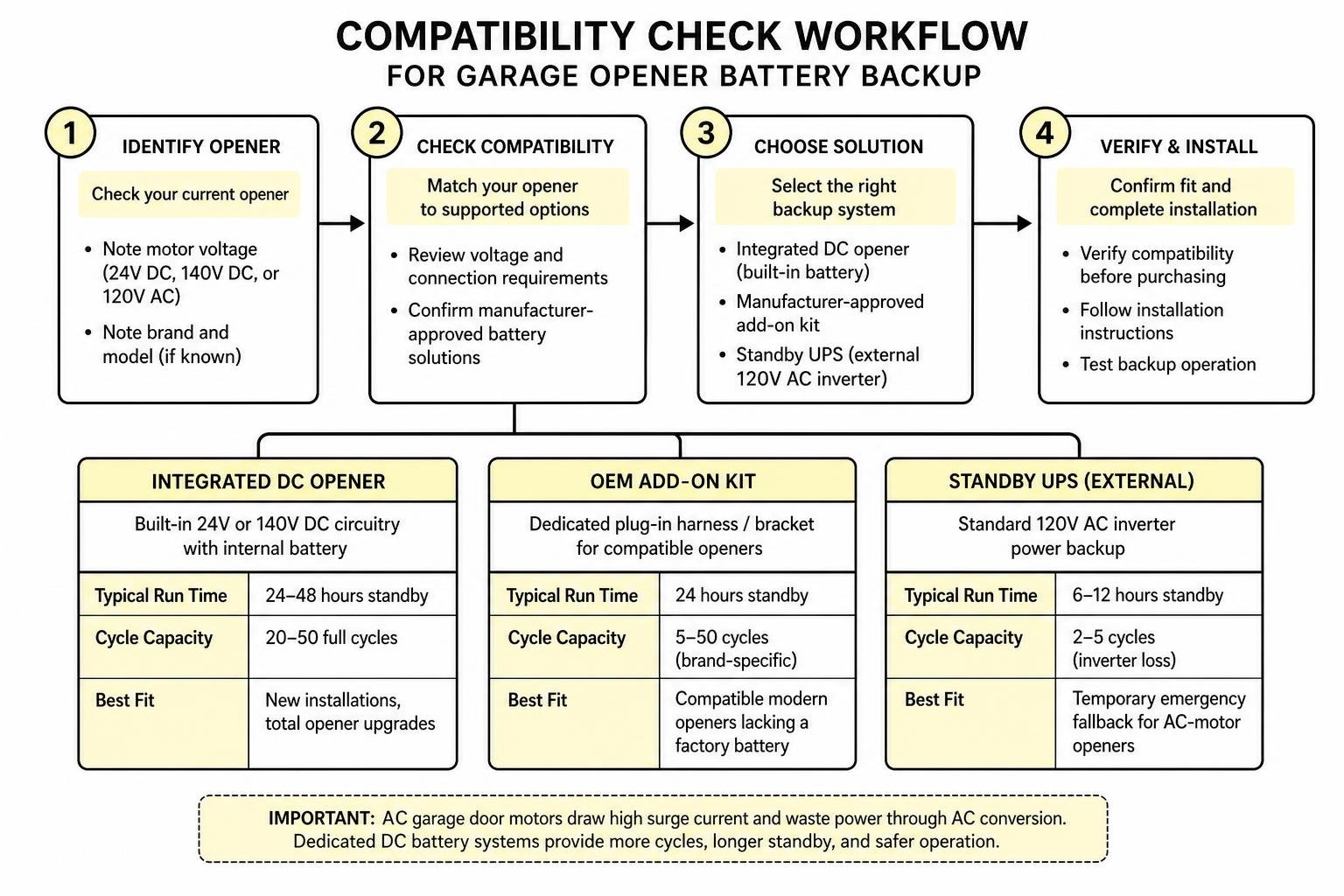
When selecting backup power for your overhead door, you have three distinct hardware options: factory-integrated DC openers, manufacturer-approved add-on kits, and external uninterruptible power supply (UPS) units.
| System Type | Power Architecture | Typical Run Time | Cycle Capacity | Best Fit |
|---|---|---|---|---|
| Integrated DC Opener | Built-in 24V or 140V DC circuitry | 24–48 hours standby | 20–50 full cycles | New installations, total opener upgrades |
| OEM Add-On Kit | Dedicated plug-in harness / bracket | 24 hours standby | 5–50 cycles (brand-specific) | Compatible modern openers lacking a factory battery |
| Standby UPS (External) | Standard 120V AC inverter | 6–12 hours standby | 2–5 cycles (inverter loss) | Temporary emergency fallback for AC-motor openers |
Brand-Specific Options and Compatibility
Different manufacturers use distinct proprietary designs for their backup power systems:
- LiftMaster / Chamberlain: Modern units like the LiftMaster DC battery backup wall mount opener and the 81602 DC Battery Backup Chain Drive Wi-Fi use sealed lead-acid (SLA) battery modules built right into the powerhead, driving heavy doors up to 850 lbs smoothly.
- The Genie Company: Genie features dedicated add-on kits like the Genie Garage Door Opener Battery Backup 39524R for 24V operators (providing up to 50 cycles in a 24-hour period), as well as the Genie 140-volt motor battery backup and Genie 41590R BB140-BX for 140V powerheads, which deliver up to 24 hours of reliable backup operation.
- SOMMER: SOMMER evo+ and pro+ operators utilize the SOMMER Accu backup battery, a compact internal NiMH pack rated for up to 5 cycles or 24 hours of standby operation.
Dedicated Battery Kits vs. Standard UPS Units
Some homeowners attempt to connect standard computer UPS (Uninterruptible Power Supply) battery backups to older AC garage door openers. While a 1500VA pure sine wave UPS can occasionally lift a door once or twice, it is rarely an ideal long-term solution.
AC garage door motors pull a massive surge of inrush current at startup—frequently tripping standard consumer UPS overload circuits. Furthermore, consumer UPS units waste substantial power constantly inverting DC battery power into 120V AC, rapidly depleting reserves within hours even when the door is not in use. Dedicated OEM kits supply low-voltage DC power directly to the motor electronics, maximizing runtime and mechanical safety.
Key Features to Look For in a Modern Battery Backup System
If you are upgrading your opener system, look for modern conveniences and safety protections:
- Smart Connectivity: Built-in Wi-Fi and Bluetooth allow systems like Chamberlain/LiftMaster myQ or Genie Aladdin Connect to send mobile push notifications if the main power drops or if battery health is low.
- Soft Start and Soft Stop: DC motors gradually accelerate and decelerate, reducing strain on hardware and lowering energy draw from the battery.
- Power-Managed Lighting: Opener systems automatically disable high-draw courtesy work lights while operating on battery power to conserve reserve energy for lifting.
Battery Capacity, Voltage, and Chemistry
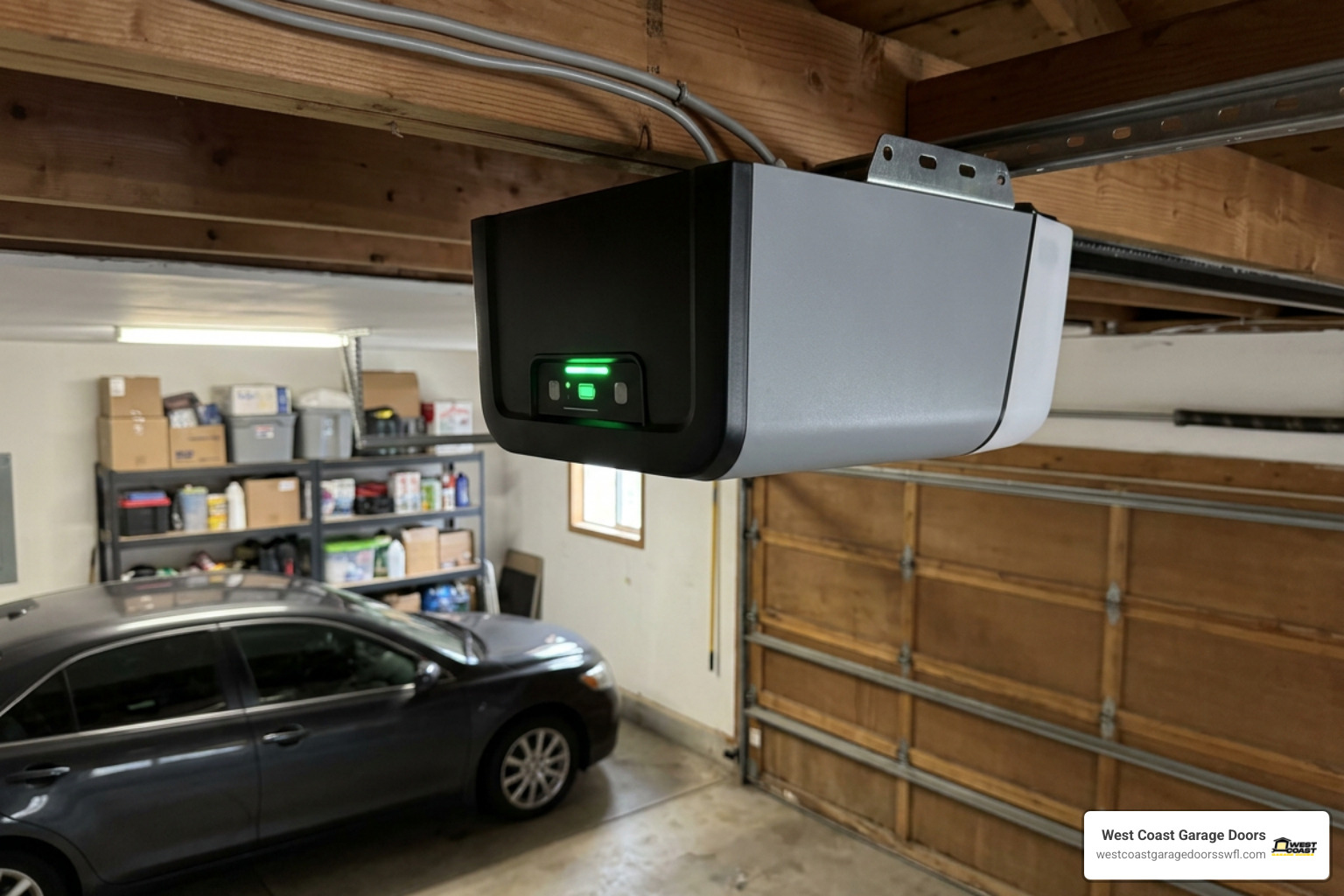
Most residential garage door openers use Sealed Lead-Acid (SLA) Absorbent Glass Mat (AGM) batteries, typically rated at 12V 4.5Ah or 12V 8Ah. Some European systems, such as SOMMER, use Nickel-Metal Hydride (NiMH) packs. High-quality systems feature integrated control boards that prevent both deep discharge (which destroys battery cells) and overcharging during standby operation.
Safety Systems and Sensor Integration
Even when running entirely on auxiliary battery power, your door must maintain all core entrapment and safety protocols. Modern backup systems power the optical garage door safety sensors, ensuring that the auto-reverse mechanism instantly stops and reverses door travel if children, pets, or vehicles block the doorway. Systems also incorporate clear audible beeps to warn homeowners that the opener is operating on auxiliary power rather than standard household voltage.
Installation, Maintenance, and Replacement Guidelines
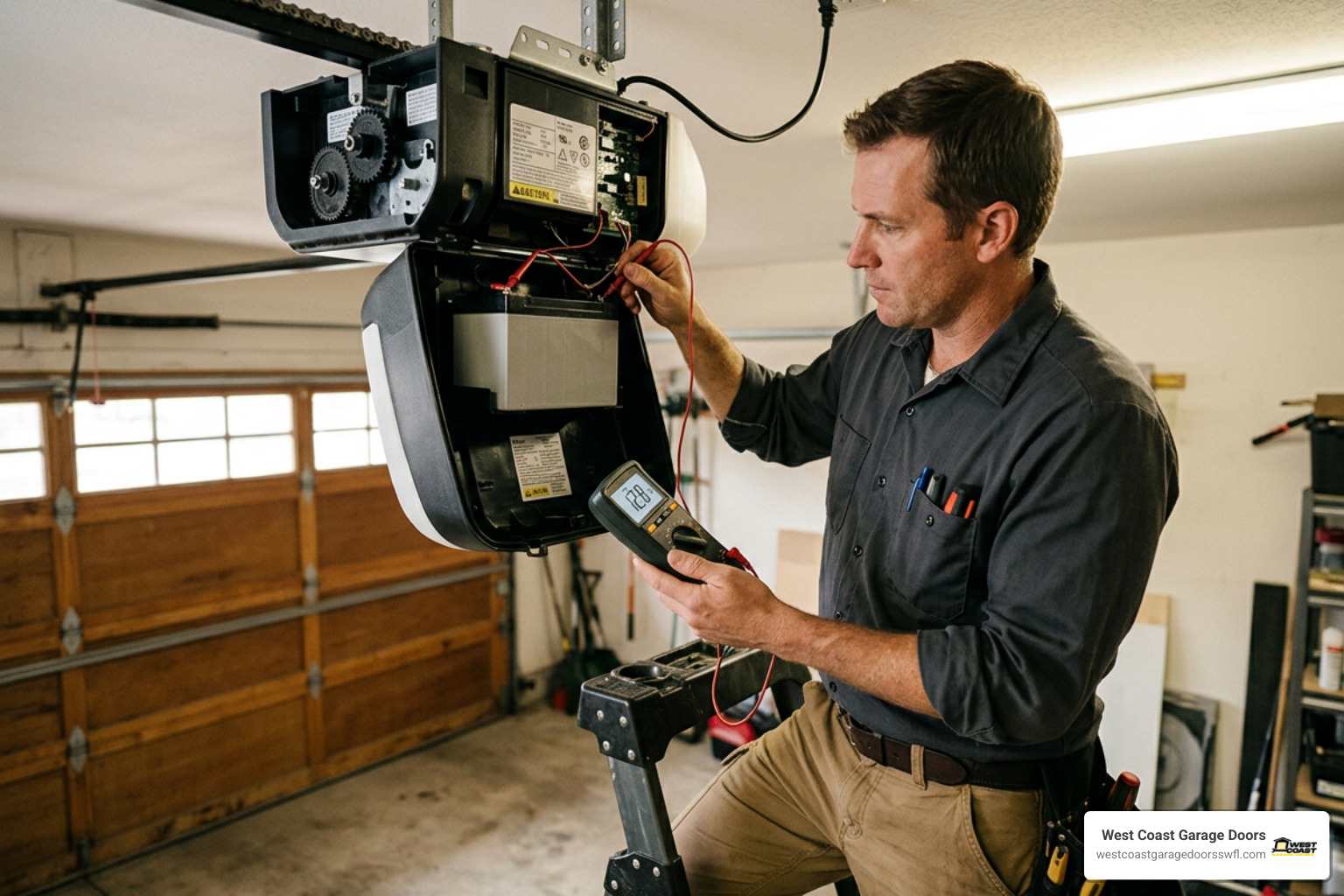
Proper installation and routine inspection keep your battery system ready for severe weather events.
Installing a Garage Door Opener Battery Backup Safely
If you are adding an OEM add-on battery kit to a compatible motor head:
- Disconnect Main Power: Always pull the opener’s main power cord from the ceiling outlet before opening battery compartments or wiring terminals.
- Mount the Bracket Securely: Fasten the battery tray or bracket to the motor chassis or adjacent ceiling angle iron using the supplied hardware. Never drill unauthorized holes into the motor casing.
- Observe Correct Polarity: Connect the red wire to the positive (+) terminal and the black wire to the negative (-) terminal. Reversing polarity will blow internal fuses.
- Allow Full Initial Charge: Once connected and plugged back in, allow the battery to charge uninterrupted for 24 to 48 hours before testing.
If your motor experiences strange delays or mechanical binding after installation, review our guide to troubleshooting opener performance to verify proper spring balance and track alignment.
Signs Your Garage Door Opener Battery Backup Needs Replacement
With normal usage, LiftMaster, Chamberlain, and Genie backup batteries last approximately 1 to 2 years. Signs that your battery requires immediate replacement include:
- Audible Beeping Alerts: The opener powerhead emits a chirp every 30 to 60 seconds.
- Diagnostic LED Indicators: The battery health LED turns solid red or flashes yellow/red, signaling that the cell can no longer hold an adequate charge.
- Failure Under Load: The door initiates motion but stops after lifting just a few inches when utility power is unplugged.
When battery replacement or mechanical service is needed across Southwest Florida, scheduling a professional repair service ensures your overhead door system is properly balanced and fully operational before storm season arrives.
Frequently Asked Questions About Garage Door Battery Backups
Can I retrofit a battery backup onto an older garage door opener?
You can only retrofit a dedicated battery backup kit if your existing opener has a compatible DC motor and a control board built with dedicated backup battery terminals (such as select Genie 140V/24V or Chamberlain DC models). Traditional AC-motor openers cannot accept OEM add-on battery packs; bringing battery backup capabilities to these systems requires installing a modern DC-powered opener.
How many open and close cycles will the battery provide during a blackout?
Depending on the model, a healthy, fully charged battery will deliver between 5 and 50 full cycles within a 24-hour period. Standard Genie 24V units are rated for up to 50 cycles, while compact systems like the SOMMER Accu provide approximately 5 cycles. Heavy or improperly balanced doors will consume significantly more power per cycle, reducing overall reserve capacity.
Why does my garage door move slower when running on battery power?
Garage door openers intentionally reduce motor speed when operating on battery reserves. This soft-running mode conserves energy, limits thermal motor strain, and protects the battery from rapid voltage drops, ensuring the system retains maximum energy for subsequent emergency cycles.
Conclusion
Living in Southwest Florida means staying prepared for sudden power outages and storm-related grid failures. Investing in a reliable backup battery system guarantees that your garage door remains an accessible, secure entryway when the power goes out.
At West Coast Garage Doors, our locally owned team provides prompt, dependable installation, maintenance, and replacement across Cape Coral, Fort Myers, Sanibel, Pine Island, Matlacha, Naples, and Bonita Springs. Whether you need a replacement battery for an existing unit or want to upgrade to a hurricane-rated opener with integrated backup power, our technicians are here to help. Explore our full range of professional garage door services in Southwest Florida to keep your home safe, compliant, and storm-ready year-round.