

Understanding How a Garage Door Extension Spring Operates
Finding the exact garage door extension spring requires matching four key specifications: door height (travel stretch), door weight (measured with a scale or identified by DASMA color codes), relaxed spring length, and end type (single loop, double loop, or clipped ends). In an overhead counterbalance system, extension springs mount parallel to horizontal tracks, stretching outward as the door closes to accumulate mechanical energy. When opening, the coils contract to release stored force through lift cables and pulleys, making heavy doors virtually weightless.
Residential extension springs are typically rated for 10,000 door open-and-close cycles, translating to roughly seven to ten years of service for an average household. However, metal fatigue gradually degrades coil elasticity before a total snap occurs. Understanding how to know when your garage door springs need replacement helps prevent sudden failures that leave vehicles trapped inside or cause structural damage to track assemblies.
How Extension Springs Differ from Torsion Systems
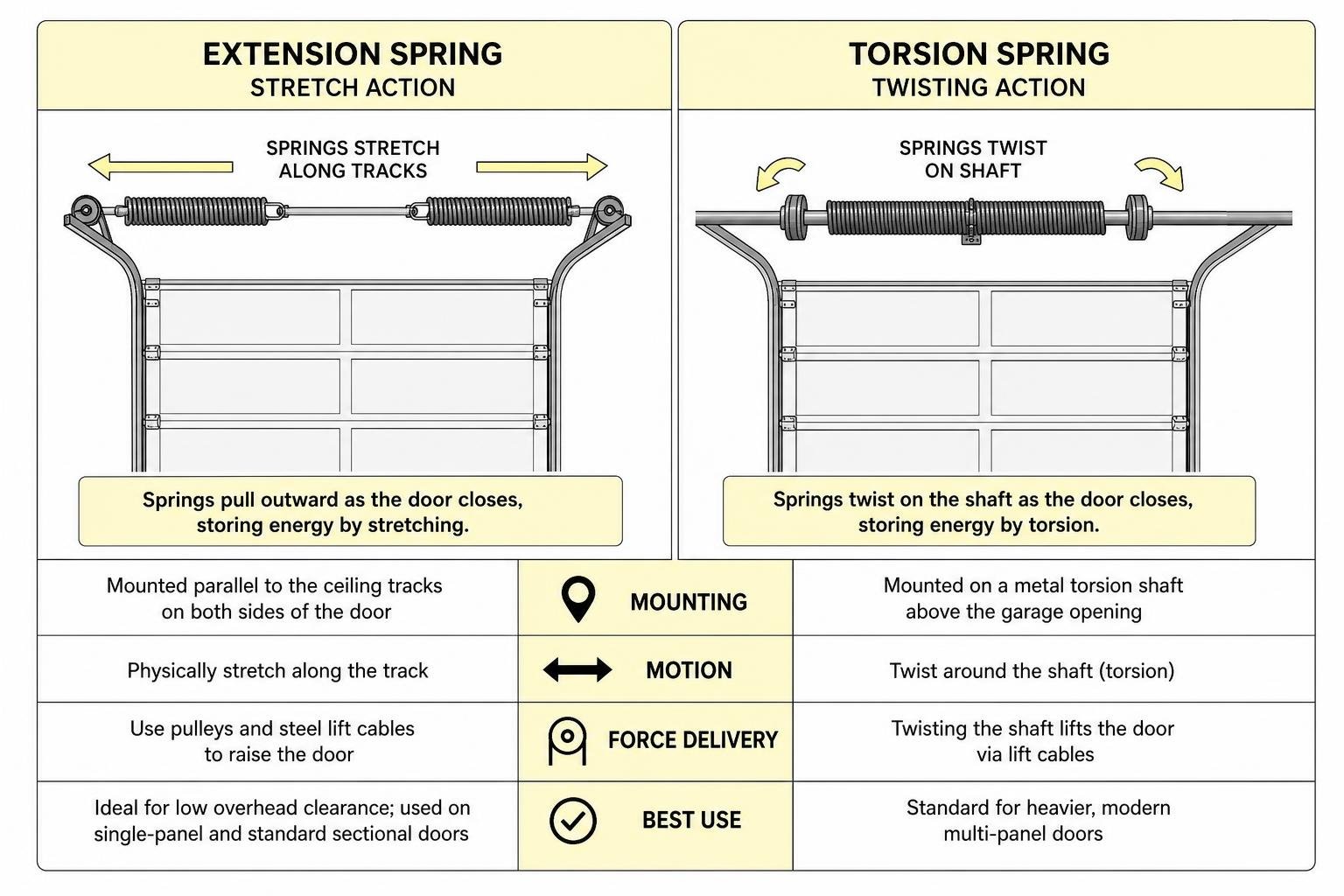
The primary difference between spring systems lies in how they mount and generate lifting force:
- Torsion Springs: Mounted directly on a metal torsion shaft above the garage opening, these springs twist (torsion) to store power. They are standard for heavier, modern multi-panel assemblies and require adequate overhead clearance.
- Extension Springs: Mounted parallel to the ceiling tracks on either side of the door, these springs physically stretch along the track length. They are ideal for garages with low overhead clearance and remain popular on single-panel doors as well as standard sectional doors.
How to Measure and Identify the Exact Replacement Extension Spring
Ordering the wrong replacement spring compromises door balance, accelerates opener wear, and creates substantial safety hazards. Finding an exact match requires four core measurements: door height, door weight, relaxed spring length, and end configuration.
Sizing Your Garage Door Extension Spring by Height and Stretch
Extension springs are engineered around door travel distance. A spring designed for a 7-foot door does not have the stretch capacity needed for an 8-foot door and will overstretch, deform, or snap prematurely.
- 7-Foot Garage Doors: Standard setups utilize a 25-inch relaxed spring length engineered for 42 inches of stretch travel.
- 8-Foot Garage Doors: Standard configurations require a 27″ x 48″ for 8′ Garage Door Extension Spring – Clipped Ends (Sold Ind or standard loop setup with 48 inches of stretch travel capacity.
Always measure the spring when the door is fully raised in the open position so the spring is completely relaxed (unwound and under zero tension).
Weighing the Garage Door and DASMA Color Codes
Springs are calibrated to balance the total dead weight of the entire door. Because springs are installed as a pair, each individual spring supports exactly half the total door weight.
To weigh your door safely:
- Disconnect the electric opener by pulling the red emergency release cord.
- Raise the door fully to remove spring tension, secure both tracks with locking pliers or C-clamps, and disconnect the old springs.
- Place a standard analog or digital bathroom scale in the center of the garage floor opening.
- Carefully lower the door onto the scale. If your door exceeds single-scale limits, place two scales side by side under a flat 2×4 board and add both readings together.
The Door & Access Systems Manufacturers Association (DASMA) established an industry-standard color code painted on the spring ends to represent weight ratings. These colors repeat every 100 pounds.
| Door Weight (Lbs) | DASMA Color Code | Common Door Height Application |
|---|---|---|
| 80 lbs | Gold | 7′ / 8′ Single Doors |
| 90 lbs | Light Blue | 7′ / 8′ Single Doors |
| 100 lbs | Tan | 7′ / 8′ Lightweight Single Doors |
| 110 lbs | White | 7′ / 8′ Standard Single Doors |
| 120 lbs | Green | 7′ / 8′ Standard Single Doors |
| 130 lbs | Yellow | 7′ / 8′ Insulated Single Doors |
| 140 lbs | Blue | 7′ / 8′ Heavy Single Doors |
| 150 lbs | Red | 7′ / 8′ Heavy Single Doors |
| 160 lbs | Brown | 7′ / 8′ Double Doors |
| 170 lbs | Orange | 7′ / 8′ Heavy Double Doors |
| 180 lbs | Gold | 7′ / 8′ Heavy Double Doors |
| 190 lbs | Light Blue | 7′ / 8′ Hurricane-Reinforced |
| 200 lbs | Tan | 7′ / 8′ Hurricane-Reinforced |
| 210 lbs | White | 8′ Heavy Wind-Loaded Doors |
For instance, an 8 Ft. 210 Lbs. 27 In. X 48 In. White Extension Spring – DIY Garage Door Parts is calibrated for heavy wind-rated or insulated residential setups, while a standard 110 lbs. (50 kg) Capacity Garage Door Extension Springs, Black and White (Pair) balances lighter residential models.
Selecting the Right Garage Door Extension Spring End Types
The ends of the spring determine how it secures to the rear track hanger bracket and pulley fork:
- Single Loop (Open Loop): Common on older systems. Easy to hook into place, but the single wire loop carries all the mechanical load, making it prone to bending or shearing under heavy stress.
- Double Loop: The standard modern recommendation for doors weighing up to 200 pounds. Two full wire coils form the loop end, doubling the structural durability at attachment points.
- Clipped Ends: Designed for heavy-duty doors exceeding 200 pounds. A steel clip insert distributes the tension across several coils, eliminating stress concentrations. A heavy-duty option like the 170 LB Heavy Duty Extension Garage Door Spring (2-Pack) or heavy clipped-end models ensure structural integrity on large doors.
Essential Hardware, Safety Cables, and Why Replacing in Pairs Matters
A garage door operates as a unified mechanical assembly. When one spring breaks, the remaining spring has absorbed identical cycle wear and is near the end of its fatigue life. Replacing only one spring causes uneven tension, forcing the door to travel crookedly, bind in the vertical tracks, and overload the opener motor.
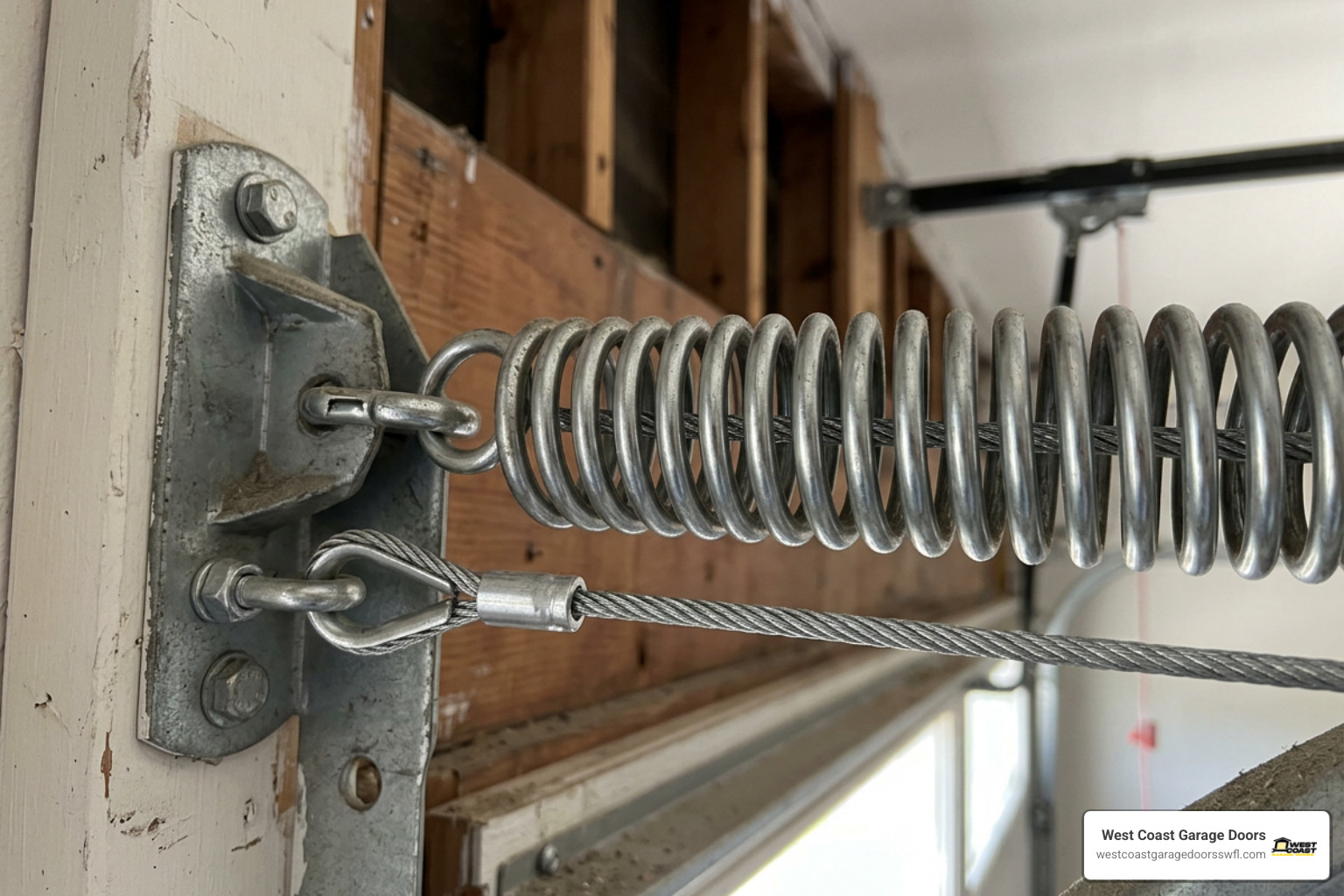
The most critical safety feature of any setup is the internal containment cable. As outlined in detailed safety guidelines on Garage Door Extension Spring — Safety and Replacement | Jaspector, an extension spring under full stretch acts like an energetic projectile if a coil fractures. Threading a high-strength galvanized steel safety cable through the center of each coil and anchoring it firmly to the rear track bracket ensures that if a spring snaps, the broken pieces remain captive rather than shooting across the garage.
When overhauling extension springs, inspect and refresh the supporting hardware. Sourcing a complete Residential Garage Door Extension Hardware Kit – 7′ & 8′ Height, Singl provides new stationary pulleys, clevis pulleys, lift cables, and heavy-duty brackets. If worn components leave you uncertain about the structural stability of your hardware, review our guide on broken garage door springs driving you crazy? Here’s when to call the pros to safeguard your home and family.
Safe Installation Steps and Maintenance Best Practices
Working with high-tension mechanical systems requires strict adherence to safety protocol.
- Disconnect the Opener: Unplug the motorized operator to prevent accidental activation.
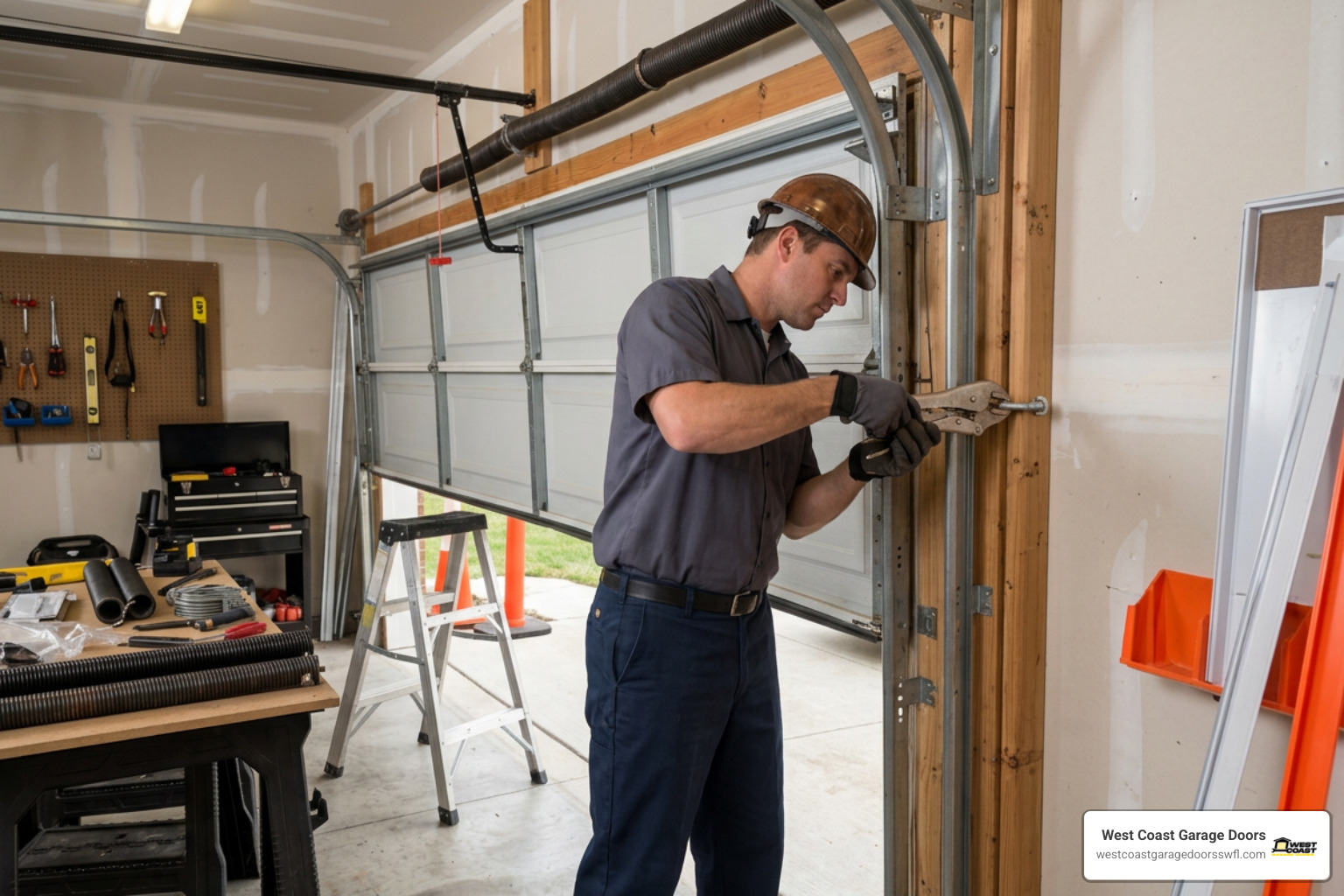
- Raise and Clamp the Door: Raise the door fully until spring tension is completely relieved. Secure locking pliers or C-clamps directly onto the tracks below the lowest bottom rollers to prevent the door from dropping.
- Replace Springs and Safety Cables in Pairs: Disconnect old springs from the track bracket and pulley fork. Thread the safety cable through the replacement spring’s interior before securing mounting hardware.
- Level the Door: Remove track clamps, lower the door manually, and check for level alignment. If one side sits higher, adjust the cable attachment hook on the track frame until the bottom seal rests flush with the floor.
- Lubricate Moving Parts: Apply non-silicone garage door lubricant to the steel pulleys and spring coils. Never apply thick grease, which attracts dirt and grit.
For complex door repairs or if your system exhibits severe structural wear, scheduling professional garage door repair protects your investment and ensures code-compliant operation.
Frequently Asked Questions About Garage Door Extension Springs
How long does a garage door extension spring typically last?
Most residential extension springs are rated for 10,000 open-and-close cycles. For standard residential usage, this provides between 7 and 10 years of reliable service. You can learn more about proper selection and longevity across different styles in our garage door springs resource section.
Can I replace just one extension spring if only one breaks?
No. Extension springs must always be replaced in matched pairs. Springs experience identical cyclic wear; leaving an old spring paired with a new one creates an uneven pull, tilts the door panels, causes rollers to bind, and risks burning out the opener motor.
Why are safety cables required on extension springs?
Safety cables run through the center of the spring coils to contain the stored energy if a spring fractures. Without safety containment cables, a snapped spring can strike vehicles, damage garage walls, or inflict severe personal injury.
Conclusion
Finding the exact garage door extension spring requires matching your door’s physical height, dead weight, and end style with precision. Installing a balanced pair equipped with proper safety cables ensures smooth, quiet, and dependable operation every time you press your remote.
At West Coast Garage Doors, our locally owned team provides prompt service, hurricane-rated hardware, and an ironclad 100% satisfaction guarantee. If you live in Southwest Florida, explore our dedicated Cape Coral garage door repair and spring services to schedule a precision spring replacement with our professionally trained technicians today!